CHAMELEONOLOGY: 

Chameleon Natural History...


During fieldwork carried out in January-February 1995 in the Strict Nature Reserve No. 9 (western Madagascar), a new species of dwarf chameleon (genus Brookesia) was discovered on the western slopes of the Antsingy forest. The inaccessible habitat of this new taxon consists of dense subhumid tropophile forest growing among the limestone blocks...

Fig 4. Live adult representatives for each species in the Furcifer verrucosus and F. oustaleti complexes. Letters correspond to clades on all other figures in this paper; males (m) on left and females (F) on right.
(a) F. verrucosus clade A (m: Fort Dauphin; f: Tsiaroa-Ampasy), (b) F. verrucosus clade B (m: Mangoky River; f: Ankatsakantsa Sud), (...

Christopher Anderson in 2018: Here is a graphic I made for some ongoing work in my lab highlighting the different parts of the axial skeleton of chameleons. This is a volume rendering of a micro-CT scan of a male Kinyongia xenorhina. In it I've segmented out and color coded the different portions of the axial skeleton as a...

Gular pouch in chameleons is an anatomical structure located in the chin are, below the mandible, which consists of an inflatable air sac (can be one or even more), attached to the breathing system via larynx and covered by skin and underlaying structures such as tendons and muscles and bones of the chin area, mainly building part of...

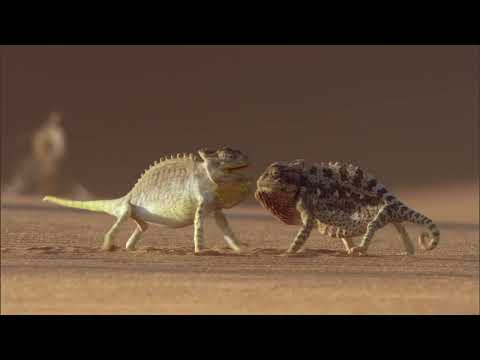
Chamaeleo namaquensis, commonly known as the Namaqua chameleon, is a species native to the arid regions of southern Africa, in Namibia and South Africa. This chameleon is characterized by its robust body, distinct color-changing abilities, and a flattened appearance that aids in camouflage among desert vegetation and rocks. Namaqua chameleons...

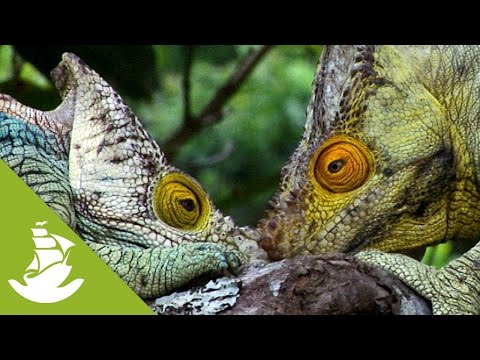
an impressive footage of the combat of two Orage-Eyed Parson's Chameleons, Calumma parsonii

Rhampheleon temporalis is a miniature chameleon exclusive to the lush forests of the Usambara Mountains in Tanzania, usually located at elevations of 1200 meters and above. These chameleons are at risk due to habitat loss. They reside in the undergrowth and grassy areas on the forest floor. Their primary coloration includes shades of gray and brown...

Calumma parsonii is a species of chameleon native to Madagascar, primarily found in the rainforests and montane forests of eastern Madagascar. The lowland population on Ile St. Marie (Nosy Boraha) seems to be extinct or near extinction same as many original populations on the eastern slopes of the central Malagasy massive.

Trioceros tempeli is an endemic of Tanzania. It is the only African chameleon species with a complete double gular crest consisting of heavily enlarged conical scales. In Africa, only Trioceros laterispinis has a similar crest, in Madagascar, an analogous gular crest you can see in Calumma capuroni.

My projects:   ARCHAIUS   │   CHAMELEONS.INFO