
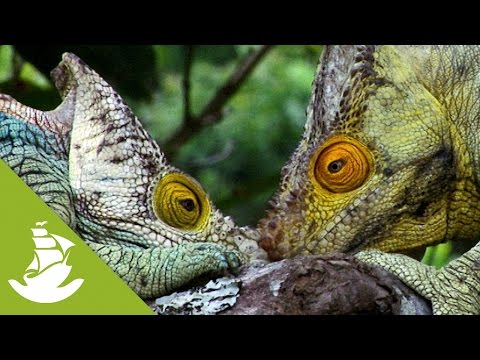
Wrath of Titans
09/09/2024
an impressive footage of the combat of two Orage-Eyed Parson's Chameleons, Calumma parsonii
an impressive footage of the combat of two Orage-Eyed Parson's Chameleons, Calumma parsonii

Vosseler's chameleon is relatively small, often reaching up to 15-20 cm (approximately 6-8 inches) in total length.

Somewhere over the rainbow, a realm of pure delight,

Rhampheleon temporalis is a miniature chameleon exclusive to the lush forests of the Usambara Mountains in Tanzania, usually located at elevations of 1200 meters and above. These chameleons are at risk due to habitat loss. They reside in the undergrowth and grassy areas on the forest floor. Their primary coloration includes shades of gray and brown...

Calumma parsonii is a species of chameleon native to Madagascar, primarily found in the rainforests and montane forests of eastern Madagascar. The lowland population on Ile St. Marie (Nosy Boraha) seems to be extinct or near extinction same as many original populations on the eastern slopes of the central Malagasy massive.

Trioceros tempeli is an endemic of Tanzania. It is the only African chameleon species with a complete double gular crest consisting of heavily enlarged conical scales. In Africa, only Trioceros laterispinis has a similar crest, in Madagascar, an analogous gular crest you can see in Calumma capuroni.

Calumma parsonii is a species of chameleon native to Madagascar. It is also known as Parson's chameleon. This largest and striking chameleon is known for its vibrant coloration and long horns on its head. Calumma parsonii is primarily found in the rainforests and montane forests of eastern Madagascar. The lowland population on Ile St. Marie (Nosy...

Not all chameleon species are known...
here, pictures of two undescribed species from Madagascar: one from Mts de Ambre, one from Nosy Komba...

A very little is known about the Cherangani Casqued Chameleon, called also Mount Mtelo stump-nosed chameleon or Pokot chameleon: Trioceros nyirit, Cherangani Hills, NW Kenya...
It was first discovered by Dr. Milos Jirku in 2004, but the priority of its description took Stipala (2011), being simply quicker in the formal description publication...

A beautiful young male of the Usambara Three-Horned Chameleon, Trioceros deremensis. Unlike the notoriously known Jackson´s Three-Horned Chameleons, Trioceros jacksonii, which give birth to living offspring, these beautiful cousins of them lay eggs…

Rhampholeon temporalis, commonly known as the Usambara pygmy chameleon, is a fascinating species of chameleon endemic to the Usambara Mountains in Tanzania. This diminutive reptile is notable for its small size, typically measuring around 8-10 centimeters in length, and its remarkable camouflage abilities, blending seamlessly into its forest...

Chameleons, popular for their ability to change skin color to match their surroundings, offer interesting insights into physics as a science in several ways:1. **Optics**: The chameleon's color-changing ability involves specialized cells called chromatophores. These cells contain pigment that can expand or contract, affecting the wavelengths of...

The Chameleon Spider - Misumena vatia

Chameleon skin is not penetrable by water. This unique trait is advantageous in regions with minimal rainfall as it helps chameleons prevent water loss. By effectively isolating water from their skin, chameleons can conserve precious hydration in arid environments where water sources are scarce. This adaptation enables them to thrive in habitats...

A comprehensive and detailed Guide to Reptiles and Amphibians of Kenya, compiled by my friend Patrick Kenyatta Malonza and B.A. Bwong. A must have for an African Herpetologist...

An interesting online publication...

The chameleons are the dragons of our times. They are equally bizarre and unusual with all the strange horns and scales and casques and structures on their heads and bodies…


The golden rule of handling chameleins sounds: never handle a chameleon unless absolutely necessary.

in 2024, the 10th WCH will be held on 5.-9.August, in Kuching, Sarawak, Borneo...

Chamaeleo calcarifer was described by Peters in 1870 as Chamaeleo calcaratus and the type locality was erroneously given as Bembatuka [= Bombetoka] (in error for Arabian Peninsula; probably near Aden, Yemen).

Chameleons do not tend to build permanent pairs.

The Machakos population of the Jackson's Three-horned Chameleon, Trioceros jacksonii, is the one where the males are exceptionally colorful.

There is a cute story about the recently deceased Queeen Elizabeth II: she had a pet chameleon when young…

The Giant Jackson´s Chameleon, Trioceros jacksonii xantholophus is a real jewel,

A discoloration in a wild female of Furcifer pardalis from N of Ambilobe, Madagascar was observed in December 2019.🙂

The handbook of Amphibians and Reptiles of North-East Africa, has finally found a way into my collection!

In the beginning of eighties, Johannes Peter Fritz and Felix Schütte were the first brave travellers collecting herpetological data in Yemen. They also collected some data on the Yemen chameleon.

The UV light is a very important factor for the chameleons, being of vital and lethal significance for them. It helps them to survive and kills them at same time. Learn more about UV light in the wide context of chameleon life on this video:
