

"Me and my girlfriend have one room full of panther chameleons and Jackson's with fake plants and real plants in the cages. Over 2 years not one lizard has gotten sick."
"Me and my girlfriend have one room full of panther chameleons and Jackson's with fake plants and real plants in the cages. Over 2 years not one lizard has gotten sick."

The Namaqua chameleon is often portrayed as the "fastest" chameleon, a desert sprinter unmatched by its relatives.

This myth is usually misapplied from Chamaeleo namaquensis, the Namaqua chameleon of southern Africa, and then generalized to all chameleons.

Some hobbyist forums and even certain videos claim that chameleons hydrate by absorbing water through their skin, or that bathing and showering them is beneficial.

Captive-bred mutations like albino or translucent chameleons are often mislabeled as if they were naturally occurring species. This misrepresentation spreads through pet trade marketing and careless terminology.

In parts of eastern Madagascar, a tale is told that touching a chameleon causes its death, and worse—that a curse will fall upon the person who touched it, or even upon their children. It's a dramatic exaggeration, a folkloric shield woven into rural storytelling.

Beginners often treat chameleons like iguanas, assuming they can thrive on lettuce, fruit, or other plant matter.

It's often repeated that, unlike geckos, chameleons never consume their shed skin for nutrition.

Popular culture loves to imagine chameleons as reptilian magicians, locking eyes with a cricket until it falls into a trance. Supposedly, the insect is mesmerized, frozen, and helpless—like a cartoon villain's victim.

Keepers often assume that female chameleons only require special care when actively bred. If not paired with a male, they are thought to be "maintenance-free."

This myth persists because people equate survival in the wild with inherent strength. In reality, both wild-caught and captive-bred animals have aspects that can appear "strong" but also carry hidden weaknesses.

Some keepers and pet stores promote mixed-species terraria, suggesting that chameleons can coexist peacefully with other reptiles like geckos, anoles, or even other chameleons.

Some keepers assume that tap water is universally safe for chameleons, especially if it appears clear and odorless.

Some keepers argue that chameleons can thrive indoors without UVB lighting if they are fed calcium and vitamin D3 supplements.

Many people believe that if a chameleon loses its tail, it will simply grow back, just like geckos or some other lizards. This assumption leads keepers to underestimate the seriousness of tail injuries, thinking they are reversible.

People often insist that common sense should be the guiding principle in chameleon husbandry. At first glance, this seems logical and easy to understand. Yet the result is catastrophic: starving, mishandled animals, husbandry riddled with mistakes, prejudices, and anthropomorphic misbeliefs.

Described by Colin Tilbury in 1998, Trioceros balebicornutus is one of the most distinctive African chameleons. Endemic to the Bale Mountains of central Ethiopia, it inhabits moist montane forests and forest edges at elevations above 2,500 m. Its name reflects the striking paired rostral horns of adult males, which give the species a specific...

Brookesia thieli is a small leaf chameleon endemic to Madagascar, assessed by the IUCN as Near Threatened due to ongoing habitat loss. Typically, this species is described as perching close to the ground, often within 10–50 cm above the forest floor at night, where its cryptic coloration blends with leaf litter and low vegetation.
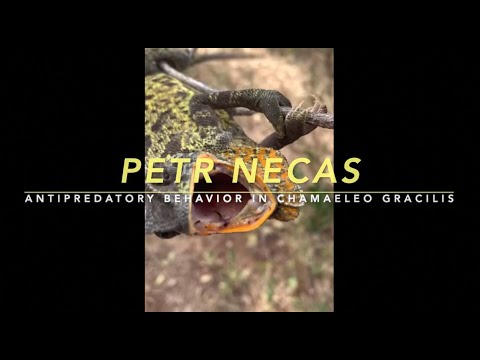
The Slender Chameleon (Chamaeleo gracilis) of Kenya is not only admired for its subtle camouflage but also for its dramatic defense behavior. When threatened, this species performs a striking antipredatory display documented on video by Mary Greene. The chameleon inflates its body to appear larger, while its skin shifts to vivid, contrasting tones...

Because veiled chameleons (Chamaeleo calyptratus) are exotic pets, some argue they are simply non‑native residents in Florida, harmless curiosities rather than invasive threats.

Discovered and described in 2003 by Necas, Modrý, and Slapeta, Trioceros narraioca is one of East Africa's most enigmatic reptiles. Known as the Mount Kulal stump-nosed chameleon, it inhabits the isolated dry montane forests of Mount Kulal in northern Kenya. Its distinctive morphology sets it apart from related species.

Brookesia stumpffi, the Plated Leaf Chameleon of Nosy Be, is listed as Least Concern by the IUCN, yet it remains one of Madagascar's most fascinating pygmy chameleons. Its hatchlings are especially remarkable, with a lichen-like camouflage and a distinctive white spot between the eyes, and they share their microhabitat with the even...


For over two decades, the organisation ARC, preceded by EDEN, has worked tirelessly in western Madagascar to restore natural forests through large-scale reforestation and community development programs. One of their most remarkable project sites is Antsanitia, a location beloved by the people of Mahajanga as a weekend retreat thanks to its peaceful...

Brookesia nofy is among Madagascar's most diminutive chameleons, a leaf‑litter specialist whose very name—nofy, meaning "dream" in Malagasy—captures the delicate, almost unreal quality of its existence. Endemic to the humid forests of northwestern Madagascar, this species inhabits the microhabitat of leaf litter and moss, where its cryptic...


Calumma malthe is a real treasure of the rainforest. Get inspired by its beauty...

The black coloration of the oral cavity in reptiles is a rare and striking phenomenon. While most snakes and lizards display pale or lightly pigmented mouths, a handful of species across continents reveal jet‑black inner linings. This adaptation transforms a simple gape into a dramatic spectacle, raising questions about its evolutionary function.

Panther chameleons (Furcifer pardalis) in Florida represent a troubling case of non‑indigenous reptiles establishing feral populations, driven largely by the exotic pet trade, careless releases, and even natural disasters. Their presence highlights regulatory gaps and ecological risks that demand urgent attention.

This is not just a myth — it is a dangerous superstition.