

Trioceros camerunensis is one of the rarest chameleon species at all, it is almost unknown and only few museum specimens are known. It has also been depicted only few times, so almost no one knows how it looks in life, its biology remains a mystery.
Trioceros camerunensis is one of the rarest chameleon species at all, it is almost unknown and only few museum specimens are known. It has also been depicted only few times, so almost no one knows how it looks in life, its biology remains a mystery.

Hatchling of Chamaeleo arabicus

Kinyongia multituberculata is a chameleon species endemic to the montane forest zone of the West Usambara Mountains in Tanzania, specifically found at elevations between 1,500 and 2,000 meters. This species exhibits a flattened body with multiple prominent tubercles. Kinyongia multituberculata is largely arboreal, inhabiting the understorey...

Chameleons have, based on our recent knowedge, very limited sense of olfaction and vomerolfaction...
Though, we can observe them to lick branches with exposing a little bifurcated tip of the tongue few millimeters out of the mouth...
Sometimes they even sense the air...
It seems to be a standard vomerolfaction procedure, as seen by many other...
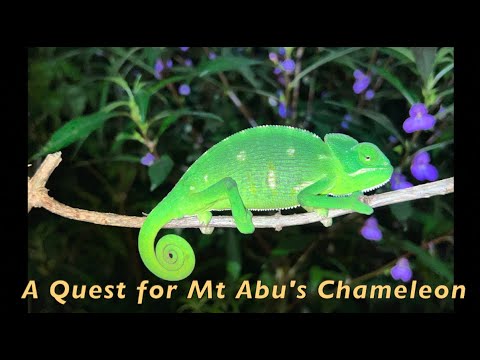
Join me on an exhilarating journey, one filled with mystery and discovery, as we set out to seek the elusive Indian Chameleon, Chamaeleo zeylanicus, in the picturesque Hills of Mt. Abu, Rajasthan, India. This adventure promises an exciting blend of nature exploration, cultural immersion, and the thrill of encountering one of the most remarkable...

Brookesia therezieni, also known as the Perinet leaf chameleon, is a species of lizards in the family Chamaeleonidae. The species is endemic to eastern Madagascar. The International Union for Conservation of Nature (IUCN) classed the species as Least Concern. B. therezieni was initially described as a species new to science by Édouard-Raoul Brygoo...

This chameleon resides in the mountain forests of central-eastern Madagascar, particularly in Analamazaotra, part of the Andasibe-Mantadia National Park, at elevations up to 1,200 meters. They prefer humid, dense primary forests and are rarely found in secondary vegetation. Notably, in 2018, a Furcifer willsii was discovered in the stomach of a...

As we tiptoed through the rainforest, our beams illuminated these vibrant masters of disguise, who looked just as beautiful in their dreams. "What do you think they dream about?" I wondered aloud. My friend shrugged, peering into the trees."Maybe a planet full of flies and butterflies," he chuckled. "That they can munch on! They're so sweet!" Just...

Calumma osbaughnessyi is a chameleon native to southeastern Madagascar, found primarily in the dense rainforests from Ranomafana National Park to the edges of Andohahela National Park. This species thrives in humid, pristine environments rich with ferns and moss, typically avoiding secondary growth. At night, it can be observed perched on branches...

There is a common belief, chameleons can not create pink colors on their bodies. Well, most species can not. One population of the Panther Chameleon (Furcifer pardalis) in and around the settlement Ankaramibe in the North of Mahajanga Province in the NW coast of Madagascar is however typical with males which can, when sleeping or when excited,...
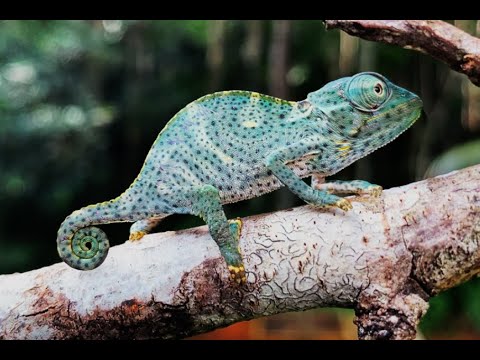
well, they simply resemble the lichens...
Read more here:
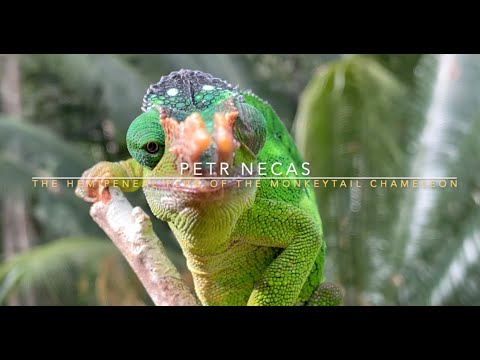
Kinyongia matschiei, shows the natural way how the shed the hemipenis rubbing the cloaca on branches while defecating
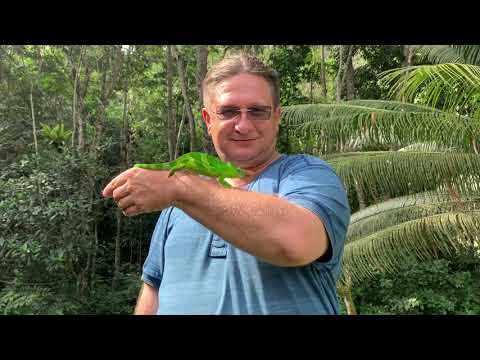
Kinyongia matschiei, called also monkeytail Chameleon because of its extremely long tail, is am amazing endemic to E Usambara Mts, TZ

The diet of the blue monkey (Cercopithecus mitis) is quite varied, primarily consisting of fruits and plant materials, with invertebrates supplementing their protein intake. Some populations have been documented to consume occasional vertebrates, such as birds, mice, scaly-tailed squirrels, and bush babies. Conversely, the golden monkey (C. m....

A unique footage of a female of the Giant Yellow Crested Three-Horned Jackson's Chameleon, Trioceros jacksonii, giving birth in Hawaii, in the Garden of Mary Lovein, recorded in 2009

Furcifer voeltzkowi was described as Chamaeleon voeltzkowi by Boöttger in 1893, named after Alfred Voeltzkow (1860 – 1947), German zoologist and botanist, who collected the type specimen at the type locality: Antema, Bembatuka Bay, Western Madagascar.

The hatching process of the Namaqua Desert Chameleon (Chamaeleo namaquensis} is described by Chantelle Bosch, the Namibian naturalist, photographer and guide as follows:


Incredible footage, artistic film, pitty that the info got twised in order to make a sensation...

Kinyongia cf. oxyrhina occurs on several isolatwd mountains or mountain ranges:

Kinyongia fischeri is one of the rarest reported Two-Blade-Horn-Chameleon species in the African continent. Described as first of all by Reichenow 1887, named after German herpetologist working in Hamburg, Johann Gustav Fischer (1819-1889).

Presented with a model of a predator bird (left), the Fiscal Shrike (Lanius collaris), chameleons (Bradypodion taeniabronchum) colour-matched their backgrounds much more closely than with a model of a snake (right). The Boomslang (Dispholidus typus) has poorer colour vision than the shrike, and therefore, it produced less vivid changes in the...

Tilbury, Colin R. & Krystal A. Tolley. 2015. Contributions to the Herpetofauna of the Albertine Rift: Two New Species of Chameleon (Sauria: Chamaeleonidae) from An isolated Montane Forest, south eastern Democratic Republic of Congo. Zootaxa. 3905(3): 345–364. DOI: 10.11646/zootaxa.3905.3.2

William R. Branch and Krystal A. Tolley. 2010. A New Species of Chameleon (Sauria: Chamaeleonidae: Nadzikambia) from Mount Mabu, central Mozambique. African Journal of Herpetology. 59:157-172. DOI: dx.doi.org/10.1080/21564574.2010.516275

Pia J. Schucht, Peter T. Rühr, Benedikt Geier, Frank Glaw and Markus Lambertz. 2020. Armored with Skin and Bone: A Combined Histological and μCT‐Study of the Exceptional Integument of the Antsingy Leaf Chameleon Brookesia perarmata (Angel, 1933). Journal of Morphology. DOI: 10.1002/jmor.21135

Pygmy Chameleons of the genus Rhampholeon represent a moderately diverse, geographi- cally circumscribed radiation, with most species (18 out of 19 extant taxa) limited to East Africa. The one exception is Rhampholeon spectrum, a species restricted to West-Central African rainforests. We set out to characterize the geographic basis of genetic...

Daniel F. Hughes, Krystal A. Tolley, Mathias Behangana, Wilber Lukwago, Michele Menegon, J. Maximilian Dehling, Jan Stipala, Colin R. Tilbury, Arshad M. Khan and Chifundera Kusamba. 2018. Cryptic Diversity in Rhampholeon boulengeri (Sauria: Chamaeleonidae), A Pygmy Chameleon from the Albertine Rift Biodiversity Hotspot. Molecular Phylogenetics and...

Böhme, Wolfgang 1997. Eine neue Chamäleonart aus der Calumma gastrotaenia-Verwandtschaft Ost-Madagaskars (A new species of chameleon from the Calumma gastrotaenia-group from eastern Madagascar). Herpetofauna. 19 (107): 5-10.

We describe Calumma vohibola sp. nov., a morphologically distinct chameleonspecies of the Calumma nasutum species group from littoral forest fragments of the northcentral east coast of Madagascar. Males and females of this species differ from all other species of the Calumma nasutum group by an almost absent rostral appendage, by acharacteristic...