CHAMELEONOLOGY: 

Chameleon Natural History...


The rediscovery of Furcifer voeltzkowi reads like an adventure story. Hidden from science for more than a century, this chameleon survived unnoticed just across the Bay of Bombetoka, only a short boat ride from Mahajanga. The reasons for its long disappearance are simple: like Furcifer labordi, it is almost impossible to find in the dry season....

David Prötzel shares his adventures from a field trip to Oman, travelling through the Dhofar Mountains and the edge of the Empty Quarter in search of the Arabian chameleon, Chamaeleo arabicus, in the wild. The journey follows his team across remote desert habitats, documenting fluorescent geckos, local reptiles, and the dramatic landscapes of...

The misuse of nose in chameleon descriptions is surprisingly common, some sources do it regularly and consistently (like e.g. www.madcham.de), and many others repeat the same mistake. Once such an error spreads, both casual readers and even scientists can adopt it unconsciously, letting the wrong term propagate through field guides, care sheets,...

We, the chameleons (Chamaeleonidae), coil our tails with deliberate mastery. The word prehensile comes from Latin prehendere — "to grasp, seize, take hold of." Many creatures have found ways to grasp, but our lineage has refined the tail into a true instrument of anchoring.

The prehensile‑tailed porcupine (Coendou prehensilis) is a forest dweller whose arboreal mastery rests in its extraordinary tail. Muscular and flexible, it coils firmly around branches, granting balance and security in the canopy. This singular adaptation mirrors the arboreal strategies of animals like chameleons, whose tails likewise serve as...

Chameleons are renowned for their ability to change colors. While specialists are well aware of the complexity of this phenomenon, the general public often remains under the impression that it serves primarily as camouflage. Although certain shades of brown or black can indeed aid concealment, the cryptic coloration of chameleons is more deeply...

The article "Diversity, Distribution, and Microclimatic Conditions Experienced by the Chameleons of the Vohimana Reserve, Madagascar" by Marquis, Gansuana, and Métrailler delivers a landmark ecological survey of Malagasy chameleons. Conducted over 195 days, the study recorded 577 individuals representing 12 species across three genera (Brookesia,...

Furcifer voeltzkowi, rediscovered in 2018 after more than a century unseen, inhabits northwestern Madagascar's dry forests. Though the range is restricted to a limited area between Katsepy and Soalala, it is actually more widespread than originally thought.

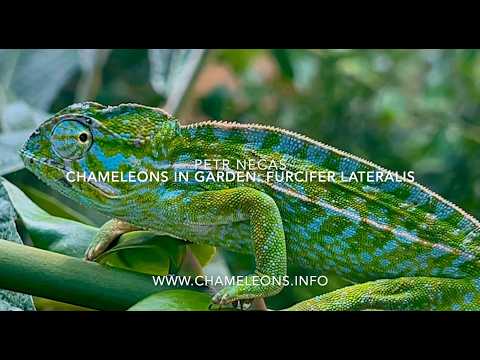
In 2012, Florio, Ingram, Rakotondravony, Louis, and Raxworthy demonstrated that the carpet chameleon complex in Madagascar actually consists of three distinct species: Furcifer lateralis, Furcifer major, and Furcifer viridis. Their DNA analysis confirmed the separation, while geography further supports the distinction.

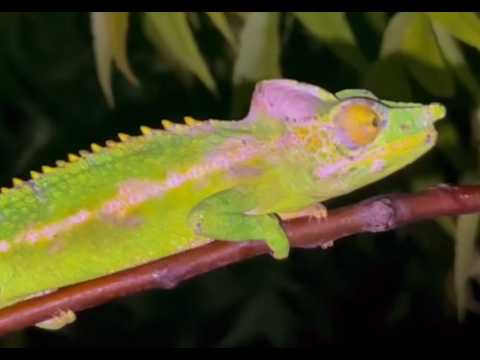
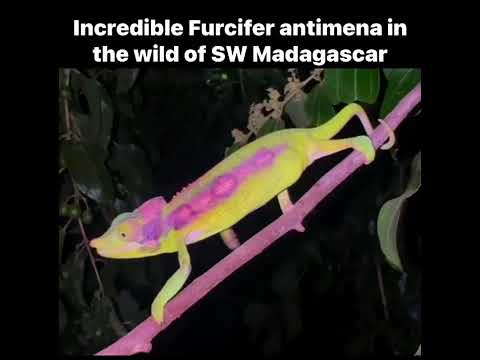
In the spiny thickets of southwestern Madagascar, Furcifer antimena reveals two distinct faces to the world. By day, this medium‑sized chameleon blends into its harsh environment, its brownish‑green body patterned with cryptic banding that makes it nearly invisible among thorny vegetation. The raised casque, short rostral appendage, and...

Furcifer belalandaensis was described in 1970 by Brygoo & Domergue and has long been regarded as one of Madagascar's rarest chameleons. Endemic to the Belalanda region in the southwest, its original range was thought to be confined to a spiny forest patch of barely four square kilometers. With its green to grey coloration, pale upper lip,...

Chameleons are notorious for their ability to change colors, but contrary to popular belief, this is not used mainly for camouflage. Instead, color change serves as a powerful tool for intraspecific communication, thermoregulation, and as a reflection of physiological and health status.

In the thorny thickets of western Madagascar, Furcifer antimena stands as one of the emblematic chameleons of the dry zone. First described by Grandidier in 1872, its very name ties it to the Antimena region, a reminder that this species is bound to the spiny forest and the dry deciduous habitats of the west.

Furcifer viridis was described in 2012 after being split from Furcifer lateralis. It is part of the same complex as lateralis and Furcifer major, but differs in clear diagnostic ways. The species is actually larger than F. major, with males reaching close to 28 cm in total length. Its diagnosis rests on scale counts along the cranial crests...

Pair bonding in chameleons was first reported by Toxopeus, L.J. (1988). Pair Bonding in Chameleons. Naturwissenschaften 75: 307–308.

Welcome to the enchanting world where the elusive chameleon lends its mystique to an eclectic array of organisms, inspiring names and features that captivate the imagination and spark curiosity. In this article, we embark on a whimsical journey through the realm of taxonomy, exploring how the chameleon's intriguing traits have influenced the naming...

The Congolese Ituri chameleon, Trioceros ituriensis (Schmidt, 1919), has long been entangled in taxonomic uncertainty. A recent review by Wolfgang Böhme re‑examines its synonymies and raises questions about possible overlooked species.

Researchers at the University of Johannesburg investigated the prey spectrum of two dwarf chameleon species, Bradypodion damaranum and Bradypodion ventrale, in South Africa's Western and Eastern Cape provinces. The study compared individuals from natural habitats with those living in peri‑urban environments.

A recent study in Vertebrate Zoology has revealed four previously unknown species of sylvan chameleons in the genus Nadzikambia, discovered in the isolated montane "sky island" forests of northern Mozambique. Until now, only Nadzikambia mlanjensis and Nadzikambia baylissi were recognized, but integrative taxonomy combining morphology and...

Calumma cucullatum is one of Madagascar's most distinctive chameleons, described by John Edward Gray in 1831. Its name comes from the Latin cucullare, meaning "hood," a direct reference to the immense occipital flaps that extend behind the head. These flaps are the largest of any chameleon species, giving it a hooded profile that sets it apart from...

Long before we named them, we feared them. The flicker of a serpent in the grass rewired our ancestors' brains. The fear of snakes may have sharpened our vision, accelerated our reflexes, and even contributed to our upright posture, standing tall to scan the savanna for danger. Homo habilis cracked tortoise shells with the first stone tools,...

The Responsible Herpetoculture Journal (RHJ), published by the Responsible Herpetoculture Foundation, has quickly become one of the most respected platforms for reptile and amphibian keepers, researchers, and conservationists. Comparable in scope to the earlier Vivarium magazine, RHJ distinguishes itself by its international reach and its emphasis...

A paper critically revisits a single recent publication on the Chamaeleo dilepis complex. The authors question the validity of the description of C. incognitus, citing formal and factual shortcomings, and argue that elevating certain subspecies to species rank is premature. As a result, C. roperi is reverted to C. dilepis roperi and C. martensi to ...

My projects:   ARCHAIUS   │   CHAMELEONS.INFO